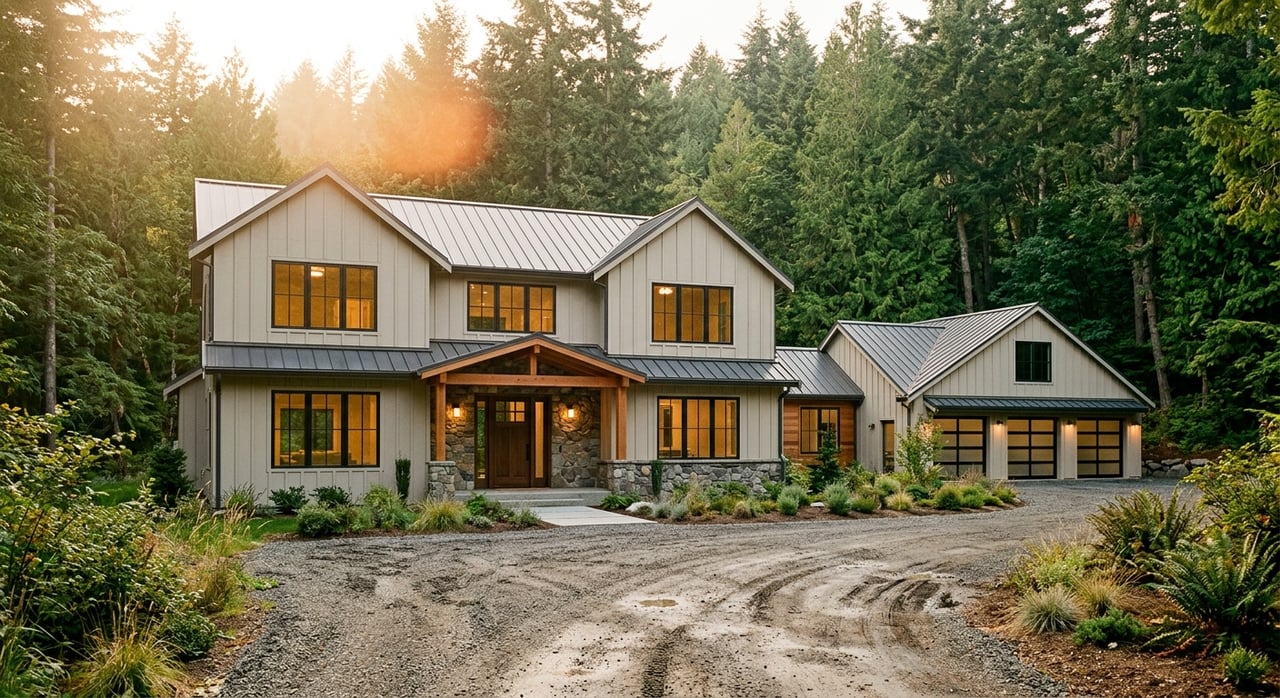
Enumclaw vs Buckley Living: Comparing Rural Lifestyles
May 14, 2026
May 14, 2026
Choosing between Enumclaw and Buckley can feel harder than it looks on a map. Both offer a small-town setting, access to open space, and a more rural feel than many parts of the greater Seattle area. If you are trying to decide where your lifestyle, land needs, and daily routine fit best, this guide will help you compare the two with more clarity. Let’s dive in.
If you want the simplest way to frame it, Enumclaw tends to feel like the larger plateau hub with a deeper rural and equestrian context. Buckley tends to feel like the smaller foothill town with a stronger historic main-street character and a more compact in-town layout.
That difference matters because buyers often start by comparing home prices alone, when the bigger distinction is usually how you want to live day to day. Lot size, road access, downtown feel, and proximity to rural land can shape your experience just as much as the house itself.
Enumclaw has about 12,798 residents across 5.2 square miles, making it the larger of the two communities. The city describes itself as a rural small-town community and notes that it is about 45 minutes from Tacoma, Seattle, or Bellevue.
For many buyers, Enumclaw reads as a place with more of a plateau identity. It still has a quaint downtown feel, but it is also tied to a broader rural landscape around it, which can make it feel more connected to acreage living and agricultural uses.
Buckley has about 5,371 residents across 3.9 square miles. City planning materials emphasize small-town charm, local businesses, and preservation of natural spaces, while local historic materials highlight railroad and logging roots.
In practical terms, Buckley often feels more compact and more centered on its historic small-town core. If you picture a foothill town with a traditional main-street feel and easy access to nearby recreation, Buckley often matches that vision well.
Enumclaw’s housing stock was about 59% detached single-family homes in 2020, with about 5,125 housing units and a 3.5% vacancy rate. That supports the idea that much of the city still functions as a lower-density detached-home market.
The zoning helps explain why. Much of Enumclaw is zoned R-1 and R-2, with minimum lot sizes of 18,000 square feet in R-1 and 8,400 square feet in R-2. Some planned developments allow a wider range, including larger estate lots and smaller cottage lots, but the overall pattern still leans toward more space.
Buckley’s land-use planning points to a tighter city pattern inside the city limits. The city includes neighborhood residential areas, higher-density residential areas, mixed-use corridors, historic commercial areas, and natural or open-space areas.
Current code materials show a 6,000-square-foot minimum lot size in the R-6,000 zone, with smaller minimums for duplexes, townhomes, and cottage clusters. That makes Buckley feel more like a traditional small-town neighborhood environment rather than a city defined by large in-town acreage.
At the city level, owner-occupied housing values are fairly close. Census QuickFacts places Enumclaw at about $498,700 and Buckley at about $506,400.
That is important because it suggests your decision may come down less to citywide value differences and more to what kind of lot, layout, and setting you want. In other words, the better question may be: do you want more in-town compactness or a stronger connection to larger-lot living?
If your goal is horse property, pasture, or hobby-farm scale land, Enumclaw has the clearer advantage. King County’s 2025 Area 40 report says the Enumclaw Plateau surrounds the city and covers about 62,000 acres, much of it made up of rural acreage with horse farms, dairies, and leisure farms.
The same report notes lower-density zoning patterns such as RA5, RA10, A10, and A35 in the surrounding area. That broader context gives Enumclaw a stronger rural-agricultural backdrop than many buyers realize when they first focus only on homes inside city limits.
Inside the city, Enumclaw still reflects some of that rural identity. The city’s FAQ says poultry is allowed in all zoning districts, with up to six fowl allowed on lots smaller than one acre and one rooster allowed on lots over one acre.
That does not mean every in-town property functions like a mini farm. It does, however, reinforce the fact that Enumclaw’s policy environment leans more rural than many suburban cities.
Buckley’s appeal is a little different. Pierce County says the Foothills Trail terminates at the White River in Buckley and will continue east into King County and Enumclaw, and the trail rules include a designated equestrian path.
That makes Buckley attractive if you want a small-town setting with access to recreation and foothill landscapes. It is a strong match for buyers who want to be near rural scenery and trail systems, even if they are not specifically searching for large acreage within town.
Enumclaw is served by Enumclaw School District. District materials show active planning for growth, including a new elementary school planned for the Ten Trails area with an opening targeted for fall 2027.
For buyers, that points to a district managing visible growth. Depending on where you are moving from, that may shape how you think about future attendance areas, transportation routines, and proximity to schools or programs.
Buckley is served by White River School District 416. The district lists White River High School, Glacier Middle School, four elementary schools, and an Early Learning Center, with district offices in Buckley.
The key comparison is not that one district is universally better than the other. It is that White River is the smaller Buckley-based district, while Enumclaw’s district shows more visible growth pressure, which can matter when you are comparing boundaries and daily logistics.
On paper, commute times are close. Census Reporter shows mean commute times of about 33.0 minutes for Enumclaw and 32.1 minutes for Buckley.
That similarity can make the two towns look nearly interchangeable at first glance. But the actual driving experience can differ depending on which route you rely on most often.
Enumclaw’s city site says it is about 45 minutes from Tacoma, Seattle, or Bellevue, and WSDOT identifies SR 164 as a main route to east Auburn, Enumclaw, and nearby areas. That makes access to major corridors a central part of everyday life for many buyers.
Buckley is especially tied to SR 410. WSDOT says the White River Bridge on SR 410 connects Buckley and Enumclaw and carries about 22,099 vehicles per day, and when it closed in 2025, detours could add up to 45 minutes.
If commute reliability is high on your list, it is worth looking beyond the city name and focusing on the exact property location and route options. A home that seems ideal on paper can feel very different if your daily travel depends heavily on one corridor.
This is one reason local guidance matters. Comparing two homes by price or square footage alone will not always show you how road access may affect your day-to-day routine.
When buyers compare Enumclaw and Buckley, they are often really comparing two different versions of rural-adjacent living. Enumclaw tends to offer a stronger bridge to acreage, equestrian use, and larger-lot character. Buckley tends to offer a smaller historic-town feel with a compact neighborhood pattern and strong access to recreation.
Neither is automatically better. The right choice depends on whether you want more land, a more compact in-town setting, easier access to trail recreation, or a town identity that feels more plateau or more foothill.
If you are narrowing down the right fit in Enumclaw, Buckley, or the surrounding Puget Sound market, working with a team that understands how lifestyle, land use, and property positioning come together can save you time and help you make a smarter move. The Breckenridge Team brings a polished, high-touch approach to buying and selling, with the local insight needed to help you compare communities with confidence.
Our team has wide reaching connections that enable us to find off the market properties for our clients. Contact us today!